Hello,Welcome to Normal Website!

Service hotline400-6177-880
Hello,Welcome to Normal Website!
Service hotline400-6177-880

Contact US
Tell:+86-571-85691658
Fax:+86-571-28867000
E-mail:service@normaltci.com
Address:North block, 9 block,, Jiangling, Binjiang District, Hangzhou, Zhejiang

Textile & Leather

Formaldehyde test
The state of Maine in the United States requires manufacturers and distributors of certain specific children's products containing formaldehyde to report to the Department of Environmental Protection (DEP) by January 21, 2016
Formaldehyde Emission Standards for Composite Wood Products in the United States - Guidelines for Panel Manufacturers
The U.S. Department of Housing and Urban Development (HUD) regulates formaldehyde emissions in composite wood products through the Environmental Protection Agency (EPA)
The concept and application of formaldehyde
Formaldehyde is one of the environmental indicators in the textile and apparel industry. It is primarily used as an intermediate reactant in the manufacture of resins and chemicals, aiming to enhance the adhesion and durability of auxiliaries on fabrics, including resin finishing agents, fixing agents, softeners, waterproofing agents, adhesives, etc. Formaldehyde, as a commonly used crosslinking agent for cellulose fiber resin finishing, is widely applied in pure or blended products (including some silk products).
The impact of formaldehyde on the human body
Formaldehyde is a toxic substance that is harmful to the protoplasm of biological cells. It can bind with proteins in the body, altering their structure and solidifying them. Formaldehyde can cause strong irritation to the human respiratory tract and skin, leading to respiratory inflammation and dermatitis. It is a trigger for various allergies, and long-term exposure to formaldehyde can cause breathing difficulties, eczema, and sensitivity. In severe cases, it can even induce cancer.
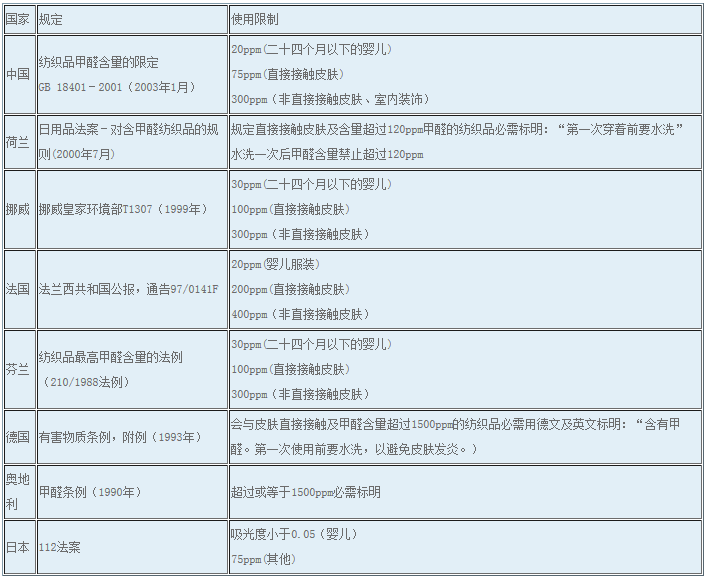
Requirements for formaldehyde in major countries around the world
During the wearing and use of textiles containing formaldehyde, some uncrosslinked or hydrolyzed free formaldehyde will be released, causing damage to human health. Therefore, major countries in the world have introduced relevant regulations or mandatory standards to strictly limit the content of free formaldehyde in products.
Standard number Standard name
AATCC 112 Formaldehyde Release from Fabrics - Closed Jar Method
EN ISO 14184.1 Textiles - Determination of Formaldehyde - Part 1: Free and Hydrolyzed Formaldehyde (Water Extraction Method)
EN ISO 14184.2 Textiles - Determination of Formaldehyde - Part 2: Release of Formaldehyde (Vapor Absorption Method)
GB/T 23973 Determination of formaldehyde in dye products
GB/T 2912.1 Textiles - Determination of Formaldehyde - Part 1: Free and Hydrolyzed Formaldehyde (Water Extraction Method)
GB/T 2912.2 Textiles - Determination of Formaldehyde - Part 2: Released Formaldehyde (Vapor Absorption Method)
ISO 14184.1 Textiles - Determination of Formaldehyde - Part 1: Free and Hydrolyzed Formaldehyde (Water Extraction Method)
ISO 14184.2 Textiles - Determination of Formaldehyde - Part 2: Release of Formaldehyde (Vapor Absorption Method)
Copyright @ 2015 NORMAL (HANGZHOU) TESTING & CERTIFICATION CO., LTD.
Tell:+86-571-28906690 E-mail:service@normaltci.com Service Hotline:400-6177-880 Fax:+86-571-28867000
If you have any comments on the website, please email to:service@normaltci.com